A clever way of avoiding sending emails; this is a travel blog designed to update my family and friends (namely my grandmother Mimi) on where I am and what I am doing during my semester abroad in Peru.
I just returned from Cusco, but parciales (midterms) are here so its going to be a while before I have time to write about my trip. So, I thought I'd post a few videos just in case anyone is getting bored. Here is just a sampling of the sounds of Lima. The jury is still out on this one...not sure if I love it or hate it.
Bowdoin has common hour; La Católica has Jueves Culturales. I took in today's concert (just inside the main gate of the university) with a very international group of friends:
Today a few of the main streets in Lima were closed so I spent even more time on the combi than usual. Here are some of the most popular radio beats-without question they are terrible-with background music like this its amazing I get any homework done on my way to school:
It’s the end of
week 7; hard to believe, but I am rapidly approaching the two-month hurdle of
my semester in Peru.Time is both
dragging along and running away impossibly fast; days in Lima last forever, but
the weeks seem to fly by without me.The
first month was a blur: orientation, Semana Santa, and an epic battle with turista, but now I am finally starting
to hit my stride.
Speaking of
striding, I joined the PUCP equipo del Atletismo (the Católica track
team).The last thing I wanted to do
with my semester abroad was participate in organized sports, but I quickly
realized that if I really wanted to meet Peruvian students I was going to have
to put myself out there.And to be
honest, college sports in Peru are nothing like athletic programs in the
states; PUCP Atletismo is way more relaxed than even my middle school track team.I show up when I want to, and do what I want
to-kind of a perfect situation.We had a
time trial at 8:30 last Sunday at the Estadio Municipal Luis Gálvez Chipoco in
Barranco.My alarm clock didn’t work, so
my host mom and the Japanese nutritionist that has been living in my casita for
the past few weeks (a story for another day) woke me up at 8:35.I threw on sneakers and athletic clothes and
hit the sidewalk running; I showed up at the stadium 20 minutes later, sweating
and panting.Julia Martinich, the coach,
wasn’t surprised that I showed up over half an hour late, but was shocked that
I had decided to run to the stadium and that I showed up in good humor.Ten minutes later I ran el mil quinientos
(1500).
PUCP Atletismo last semester.
This week a fine
Bowdoin tradition made a trans continental debut.Yes, Wine Wednesday may have happened over
Skype.And I may or may not have
finished an entire bottle by myself.After about two hours of talking with my favorite people I was ready to
go to bed, but Emma and Alec convinced me to get out of my pajamas and to go to
an event for exchange students (a gringo party in a gringo bar) in el Bar
Inglés near Parque Kennedy.I am truly
fortunate to have such a wonderful group of friends; they can even make me do things the things that are good for me from a different continent.
Who's got a bigger grin?
My women.
The IFSA program
course Realidad Social Peruana (RSP) incorporates 6 hours of volunteer work in
an NGO into the curriculum; I spend my time volunteering at the Huaca
Pucllana.I chose to not have class on Fridays only to end up devoting my free day to sorting organic material at
an archaeological site, but what can you do; if I actually had any free time I probably wouldn't know what to do with it. Unfortunately women aren’t allowed to excavate-delicate
sensibilities my ass-or I would be doing that.Classifying artifacts is dull work; the bulk of the material consists of
corn (“Si hay duda, es maiz”), carrizo (bamboo), aji (pepper), cotton, leaves, spider
webs, insects etc. but every once in a while I’ll come across a gem such as a
bone or a small piece of textile.Every
time I get cranky I have to remind myself that it’s a great opportunity, and
there is some really interesting work going on at the site.This Friday, I met a thesis student from San
Marcos who is working with a Wari mummy; there is almost no red tape in Peru,
so I got to go into the lab to see the bones and the textile bag. Unreal!
This Friday
night was a good night to be a woman in Lima or at least it was in my
casita.I had a sleepover party (or
fiesta de pijamas) with two close friends from my program: Erin and
Adrienne.We ate cookie dough and
popcorn, gave each other hair wraps, drank red wine, and watched The First Wives Club.Embarrassing, but I literally think we hit on every feminine cliché. My host family was both amused and horrified.(“Están comiendo galletas crudas.Que asco, mis borrachitas.”)I think my sleep over was probable the most
foolish and girly thing that has ever happened in my house.
Guilt and pride.
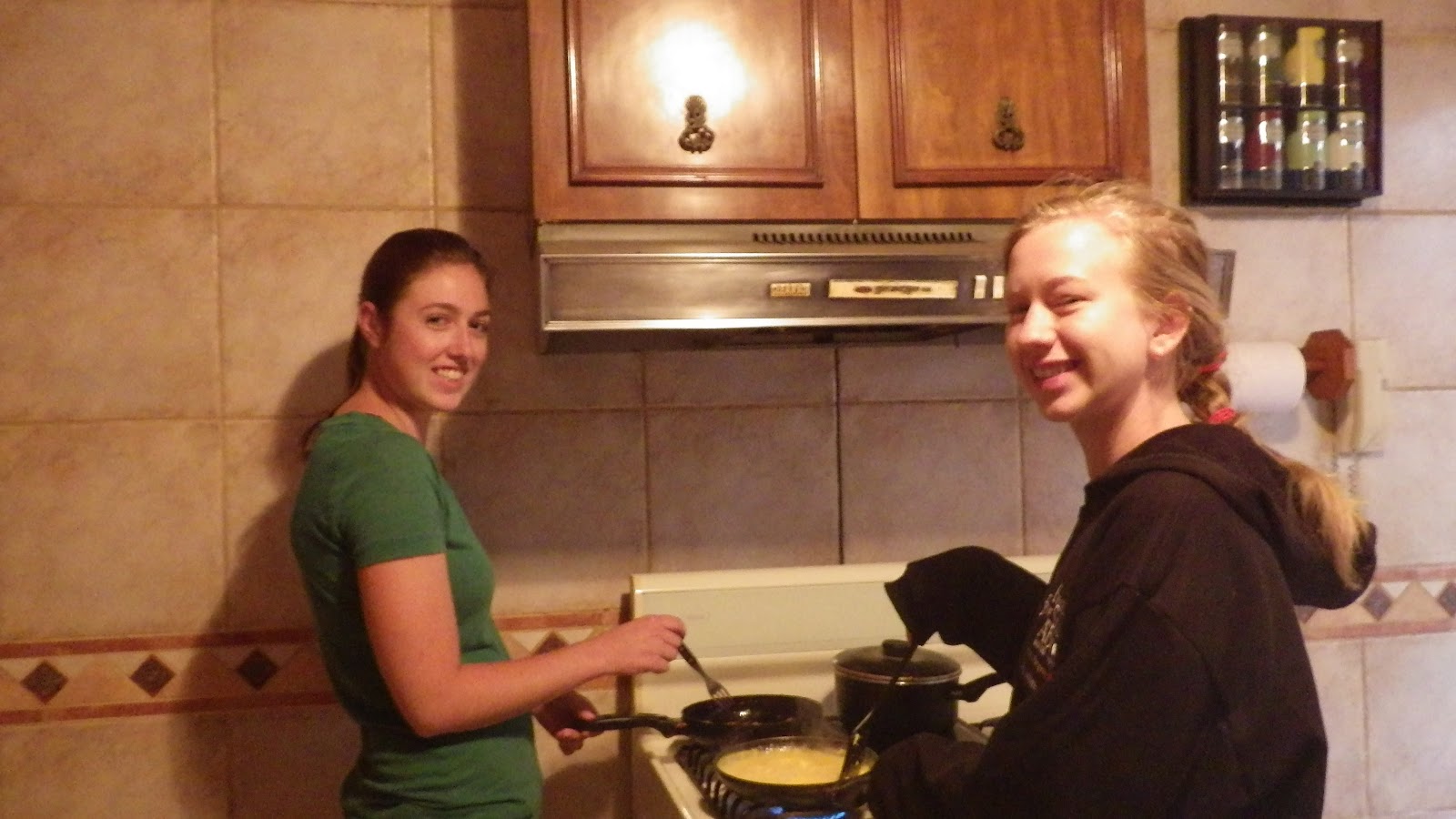
Erin and Adrienne cooking bacon and eggs.
The next day
after an American breakfast Adrienne and I went to Playa de los Yuyos in
Barranco to try our hand at Outrigger canoeing.My
middle brother Alonso is on Inkanoa, the national team, and every Saturday
between 8:30 and 12:30 they have free sessions for beginners.By some weird combination of luck and
coincidence we arrived just in time to witness the baptism ceremony of a new
boat, a super sleek one-man scull.I went
out in two different boats; the first time the canoe capsized on the shore and
the second time the sea had grown to create some intimidating swells.Sitting in the second seat I had a bird’s eye
view of everything. Climbing up the faces of the waves and literally dropping down over
the backside was hands down the most exhilarating experience I’ve had in Lima.The guys on the team were extremely friendly;
they were all pretty excited that their sport was bringing gringas to the beach.
Baptizing the new boat.
Technique demonstration.
That afternoon
the IFSA gang headed to Huaca Pucllana for a tour (the same archaeological site
that I work at); our guide, the head archaeologist, had the wonderful
propensity of all archaeologists for focusing on the grotesque and mundane.Archaeologists consider dumps to be gold
mines; as such they have a charming fascination with all things gross and
quotidian.Our tour was both
illuminating and entertaining; perhaps most interesting is the organization of space in Lima. The city's multiple faces are in constant contrast and contact, and the Huaca is no exception. Right in the heart of Miraflores, this archaeological site is a reminder of Lima's past in the midst of its present and future.
The Huaca
is an adobe and clay pyramid located in Miraflores; the site was a ceremonial
and administrative center for the Lima culture, but there is also evidence of
habitation by the Wari and Ishma cultures.We learned about the violent human sacrifices performed at the site
between 200 AD and 700 AD.Apparently,
the Lima culture was a matriarchal society; it was common practice to sacrifice
women of the ruling class to maintain control.Que bacán!
Las chicas de la Huaca: Molly, Adrienne, and I.
Lima: past and present.
Julia and Erin.
La Plaza Central and Modern Concert Venue.
Saturday night
we indulged in all you can eat sushi and pisco sours.Sunday I went for a very long run; I have
been feeling really antsy living in Miraflores-at times it’s a little to upper
class and gringo for me-so I decided to explore Lima on foot.I watched the city change faces as I passed
through several of the countless districts of Lima: Miraflores, Surco,
Barranco, San Isidro, Magdalena del Mara, San Miguel, and Pueblo Libre.In the process I discovered that its takes me
less time to run to la Católica than it does subiendo en combi.Oh well, such is public transportation in
Lima.
On Saturday the 6th the IFSA gang headed north of Lima to visit Caral, the oldest civilization in the Americas. Caral was inhabited between 2600 BCE and 2000 BCE; the site includes an area of roughly 60 hectares and probably was home to more than 3,000 inhabitants. Archaeologists have found evidence of the a knotted textile piece known as the quipu at Caral; a device used for account keeping that is usually associated with the Inca. There is no evidence of fortifications or weapons in the city; although, a variety of musical instruments, principally flutes, have been excavated. After the sweltering tour, we had an immensely satisfying lunch in a hotel restaurant in the small city of Huacho. I took advantage of the pool to rinse the dust of the ancient city away.
Now this is the desert
Angelica and I...best friends forever
The whole gang in front of the Main Pyramid
(Its 60 feet tall and roughly the size of four football fields)
Program Director Lali and a massive stone obelisk, potentially a sundial
Epic walking shot
Our tour guide
Aerial photo of the entire city
The site
And the Israelites have found the promised land...
Random Llama at our lunch spot
Chilling in the pool after lunch
On our way back to Miraflores we spotted a clown in El Centro: el payaso ladrón? Once back in Parque Kennedy we all needed a dose of familiarity; I rallied some of the group for a trip to McDonalds for ice cream and french fries. Perhaps the best and worst thing about American mass culture is that you can find it anywhere you travel.
Lima never
sleeps; the only time life in the city ever really slows is for major Catholic
holidays.The most important of these is
Semana Santa (Easter Week).Students at
la Católica don’t have class on Thursday, Friday, and Saturday (yes, as cruel
it sounds, Saturday class is kind of a thing here); as such, Semana Santa is
one of the most popular times of the year to take a short vacation.Most limeños with money escape the city for a
weekend in the provinces.According to
El Comercio during this year's Semana Santa two million Peruvian tourists
generated 630 million soles in revenue.The beaches in the region of Piuda were the most popular destination; as
far as religious tourism goes, Ayacucho took the prize with 20,000
visitors.The majority of the IFSA
students traveled to Iquitos to see “la selva”, but I traveled to Ayacucho with
three friends to witness Peru’s premier religious festival: http://elcomercio.pe/actualidad/1558734/noticia-turismo-interno-semana-santa-genero-630-millones.
I departed
Lima on Wednesday under a dark cloud; as I was printing my bus ticket, I
learned via facebook that a close friend from the ADK had unexpectedly passed
away: http://hosting-24618.tributes.com/show/Mark-Sterling-Atchinson-95481091.Truly a shock, my thoughts are with his
family and friends back in the states.For me, Mark’s death is a poignant reminder of how short life is; now is
the time to seize the day.It also provides
strange evidence of the growing capacity of social networking sites.For good or ill, Facebook is now the easiest
way to seek connection across continents and time zones.
The
overnight bus ride to Ayacucho was about a nine and a half hour affair; there
were buses departing Lima for Huamanga almost every 15 minutes.Semana Santa in Ayacucho starts on Friday the
week before Easter and last for ten days; although, the majority of the tourists
arrive on Holy Thursday of Easter Weekend.All the buses arrived at the terminal at roughly the same time; they
were loaded with luggage without an immediately apparent system of
organization.It was a cluster f***, but
we only left about an hour late.Pretty
good for Peru.I tried to sleep, but the
winding, Andean road and our driver’s aggressive passing foiled my best attempts.At 6 o’clock the attendants decided it was
time to wake up; they collected our pink blankets (the color scheme of the bus line
was Pepto Bismol) while blasting popular Latin music.
We met
Rita, la dueña of our informal hostel, at the bus station and took a taxi to
her house.Once there, we met her father
(an aging art historian) who offered to take us on a tour of the city.We broke our fast at a juice bar; we each
paid 2 soles for a blender full of fruit and vegetable juice.On our way to la Plaza de las Armas we
witnessed the tension between mestizos and indigenas; a living reminder of
Peru's post colonial heritage.Our host
showed us Ayacucho’s principal churches; Huamanga is Peru´s holiest city, home
to 33 churches, it seems as if there is “an iglesia en cada
esquina”.We also visited the University
of San Cristóbal de Huamanga, the birthplace of “el Sendero Luminoso,” Peru’s terrorism
movement of the eighties and nineties.Thursday night we joined the throngs of religious pilgrims for “la
visita a las sieta iglesias”, a walk of the seven principal churches of Huamanga.On our way home we took in “la Danza de las
Tijeras” a brilliant manifestation of the mestizo cultural:
Devan, Miles, Adrienne, and our guide en la Plaza de las Armas
Friday
morning we attended the first half of “Sermón de las siete palabras”; once I
learned that there were individual sermons for each of the 7 things that Jesus said on the
cross my hunger got the better of me.But hey, I made it to the fourth sermon.Afterward, the ATM in the plaza ate my American debit card; naturally,
the bank wasn’t open and there was absolutely nothing that I could do.I utilized my gringa charm to befriend a
security guard, who promised to help me the following morning, when the bank
was open.I was frustrated, but after
realizing there was nothing I could do I resolved to enjoy the rest of the
day.We had lunch on top of Cerro
Acuchimay and took in spectacular views of the city.On the way home we wandered past a monastery
and stopped to listen to unearthly chanting.Throughout the day talented artists covered the streets with beautiful
artwork, but that night at 8 the “Procesión del Señor del Santo Sepulcro y la
Virgen Dolorosa” turned the drawings to colored smears.All and all, the parade was terrifying
experience; the plaza was filled with people holding candles, an effigy of Jesus
in a coffin was floating above the masses, and the continence of la Virgen
Dolorosa was downright frightening.But
it was an experience.
Devan, Adrienne, and I at Cerro Acuchimay
Señor del Santo Sepulcro
La Virgen Dolorosa
Street Art
I woke up
early on Saturday to get to the bank, but by the time I arrived the line had
run the length of the Plaza and doubled back on itself.Sometimes it plays to be blonde and foreign;
my security guard from the previous day got me in with the right people, and
after clumsily explaining my situation I was told to wait.Still not sure how I accomplished it, a run
away debit card is a hard thing to navigate in any language, but after being
finger printed and waiting about 15 minutes I got my card back.Just in time to take in “La Pascua Torres”;
Peru’s version of the running of the bulls is mostly build up, but it is still
a spectacle.Riders clothed in
traditional colonial attire circle the plaza while two bulls are paraded around
on leashes; the bloodthirsty crowd, wearing almost exclusively red t-shirts, surges and retreats in
response to the path of the charging bulls.After the crowd has been satisfied the bulls are killed, and everyone
stays in the plaza to dance, eat free street food, and drink really bad
Peruvian beer. Eager to escape the throngs the four of us walked up to Barrio
Santa Ana, the artesian district, to visit weavers in their shops.
Protest about Bull Fighting
Human pyramid
Riders during la Pascua Torres
Adrienne and I in Barrio Santa Ana
The Crowd
On Saturday
night, the true festivities start; from a balcony in the plaza we watched the
first firework show of the evening.Down
in the Plaza, we made friends with a group of ayacucheños who all attend various
universities in Lima, including La Cato.I stayed up all night with our new friends watching the various
firework displays and awaiting the sunrise “Procesión de la Imagen de Cristo
Resucitado”.The 6 o’clock parade did
not disappoint; a mass of drunken men marched an enormous wooden pyramid covered in white fabric and candles around the Plaza.The pyramid listed dangerously, and the crowd stopped at
every corner to chant and garner speed for the next pass. Fireworks were launched every time the pyramid reached a corner.Flowers rained from the
Cathedral roof.The sunrise and a night
without sleep created an atmosphere of hyper reality.
Fireworks all night long
The final procession...
Unreal
We spent
all day Sunday in bed recuperating.That
night it started to rain, and when our roof started to leak I knew it was ready
to head back to Lima.The bus station in
Ayacucho (capacity 74) was packed with people. Even though our bus left an hour and half late Adrienne and I almost missed it
because of some confusion with out electronic tickets.We arrived in Lima at 8:45; I took a taxi
directly to la Católica and waltzed into class, like a true Peruvian, about 45 minutes late for my 9 o'clock
class.
Devan, Adrienne, and I in front of the Cathedral
Semana Santa
is Ayacucho was a ride, both exhausting and thrilling.I am glad I lived it once, but I am not sure
if I ever need to experience it again.